I have produced the following short video of a club traveling on the surface of an inclined plane board.
I am using a short (child's) club and I have placed the club along the surface of the board. The club is running continuously along the surface of the board and it remains in contact with the board before and after the low point of the clubhead swingarc. Note the movement of the hosel - it remains along the surface of the board and there is no rotation of the hosel off-the-board or around the sweetspot.
I believe that this visual demonstration shows exactly what is happening to a golfer's clubshaft, hosel and clubface when it travels through impact when the golfer employs angled hinging.
Do you disagree?
Jeff.
Last edited by Jeff : 01-21-2009 at 11:33 PM.
Reason: removed one sentence
I believe that this visual demonstration shows exactly what is happening to a golfer's clubshaft, hosel and clubface when it travels through impact when the golfer employs angled hinging.
Do you disagree?
Jeff.
Exactly?
Amongst other things this looks more like vertical hinging to me. In this procedure the sweetspot plane and the shaft plane are different for a prolonged distance. A reverse roll feel in the hands. The club face laying back only.
I believe that this visual demonstration shows exactly what is happening to a golfer's clubshaft, hosel and clubface when it travels through impact when the golfer employs angled hinging.
Do you disagree?
Jeff.
I appreciate your effort in the visual demonstration. But I think it misses a crucial ingredient: under centrifugal acceleration, the clubshaft bends from the drooping of the clubhead. You can now keep the grip-end of the bent clubshaft on your plane board with the clubhead swinging below the plane board. For a well matched club, the sweetspot should now be on plane too. I have no difficulty envision the rotation of the clubhead around the sweetspot under this scenario.
Analogies, however good are always somewhat flawed. So too with plane boards, rails, benches.
ob
I should add that when using center shafted, face balanced putters; 18" high rails, string lines etc would accurately represent the plane of motion as the shaft plane and the sweet spot plane are the same throughout. I think.
You wrote-: "I appreciate your effort in the visual demonstration. But I think it misses a crucial ingredient: under centrifugal acceleration, the clubshaft bends from the drooping of the clubhead. You can now keep the grip-end of the bent clubshaft on your plane board with the clubhead swinging below the plane board. For a well matched club, the sweetspot should now be on plane too. I have no difficulty envision the rotation of the clubhead around the sweetspot under this scenario."
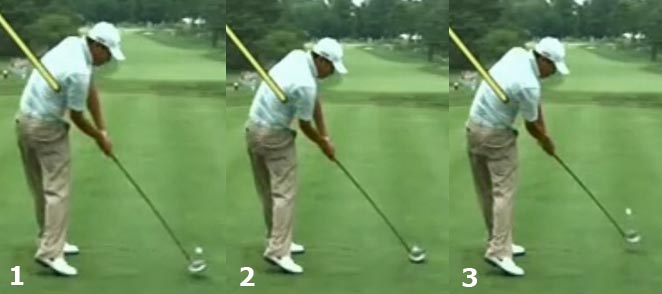
If you look at the photo series of Anthony Kim, you will see the drooping clubhead. However, there is no rotation of the hosel around the sweetspot in that composite photo. If anything, there is a visual sense that the sweetspot is rotating around the hosel of the clubshaft in those photographs. If you look carefully (using the dark grass line as a reference point) - one can imagine the hosel tracking along the surface of an imaginary inclined plane board.
OB Left
The concept of layback applies to the roll of the clubshaft while it travels along the inclined plane board. If I kept the clubshaft neutral during its travel so that the clubface was always vertical to the inclined plane board, then there could no no layback (vertical hinging). The difference between the sweetspot plane and clubshaft plane would be less in that practical demonstration if I deliberately utilized a delayed release swivel action (rather than a neutral/gradual swivel action) and if I utlized horizontal hinging. If I utilized horizontal hinging in that example, the clubshaft would still go up the plane board and the hosel would still remain on the plane board. The only difference is that the rate of clubface closure post-impact would be faster. However, the hosel would never rotate around the sweetspot - in the sense of the hosel leaving the surface of the inclined plane board.
I think that I may understand why so many golfers "feel" like the hosel is rotating around the sweetspot post-impact.
As Yodas Luke pointed out, if one rotates the club in a lathe, the axis of rotation would be through the COG of the clubhead (sweetspot) and the hosel would rotate around the sweetspot. In other words, if a golfer "feels" like he is rotating his clubshaft very actively through impact, he may acquire the "feeling" that the hosel is rotating around the sweetspot. What would cause a golfer to rotate the clubshaft actively through impact?
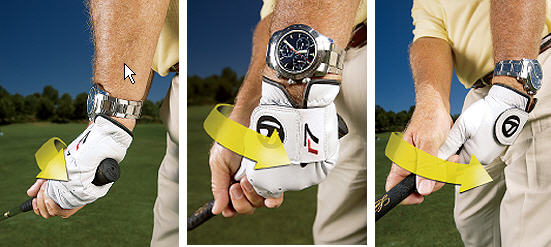
I believe that many golfers over-rotate their hands through impact under the mistaken assumption that one should have a supinated left hand post-impact, and that the clubface should be facing slightly groundwards post-impact. AJ Bonar teaches this action - called an active hand crossover release action.
AJ Bonar uses this composite photograph to make his point.
If you mimick that hand swivel action through impact, then you will certainly acquire a "feeling" that the hosel is rotating around the sweetspot.
However, the true wonder of Homer's work on hinging actions is that he demonstrated that there should be no swivel action during the followthrough phase, and that the finish swivel action must be delayed to the post-followthrough phase of the swing. During the followthrough phase, there is a small amount of clubface roll-over when utilizing horizontal hinging action, but during that HH action the left wrist remains vertical to the ground. In other words, the left wrist does not supinate during the followthrough phase, and there should not be a "feeling" of the hosel rotating around the sweetspot.
Consider this birds-eye view of Jack Nicklaus' swing.
Between impact and the fourth parallel (images 1-4) the clubface rotates 90 degrees. However, the hosel does not rotate around the sweetspot - because the clubshaft is always kept in front of his rotating body (butt end points at his navel) and there is no independent hand rotation. Note that the back of his left hand is vertical to the ground - as if there is a vertical hinge mounted in his left shoulder socket allowing the entire left arm-clubshaft to rotate at the same rpm. If more golfers pivoted as well as Jack Nicklaus post-impact, then I think that there would be less sympathy for the idea that the hosel rotates around the sweetspot post-impact.
It is true that the hosel rotates around the sweetspot when one rolls the club on a tabletop. However, that happens because the clubshaft is rotating around its longitudinal axis with no lateral movement of the entire clubshaft in space. That phenomenon doesn't happen in the golf swing. The clubshaft only rotates in space due to the fact that the left hand rotates in space - due primarily to the movement of the left arm in the left shoulder socket while the left shoulder socket simultaneously moves in space because the upper torso rotates in space. If a golfer has a synchronised swing - where the arms rotate synchronously with the rotating torso - then most of the rotation of the back of the left hand, and therefore clubface, will be due a global/proximal movement and not due to the clubshaft rotating independently around its longitudinal axis. That's what I tried to demonstrate with the Jack Nicklaus composite photograph.
I would like to see you attempt to present a solid TGM-based argument that demonstrates that the straightening right arm controls the rate/rpm of rotation of the left hand/clubface. It is my belief that the left hand controls the clubface via the biomechanical action of a hinging action (variable degree of external rotation of the left humerus in the left shoulder socket while the torso continues to rotate).






 Linear Mode


