Yoda - I applaud the effort that Yodas Luke has made to resolve this issue with a personal demonstration using the big club. Unfortunately, he couldn't keep the club on-plane post-impact so it will not convince the sceptics.
Consider my analysis of Yodas Luke's swing.
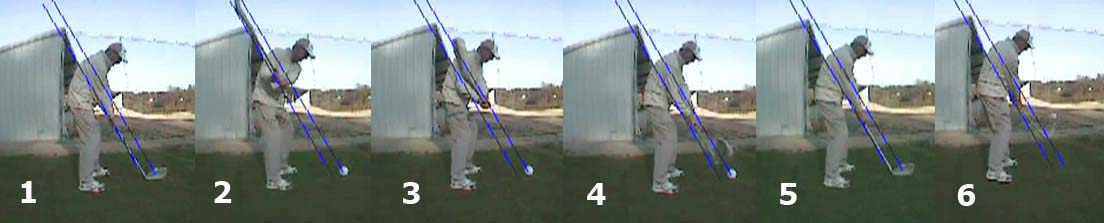
Image 1 - Address, The clubshaft is on a plane and I will arbitrarily label that plane the elbow plane. You have drawn another plane line through the sweetspot, and I will call that sweetspot plane 2. I am not calling it sweetspot plane 1, because sweetspot plane 1 apparently goes from the sweetspot to PP#3. So, I will call it sweetspot plane 2.
Image 2
That's a perfect on-plane takeaway. Note how the hosel and clubshaft remain on the elbow plane - despite a >90 degree startup swivel action. The hosel didn't leave the elbow plane and rotate to sweetspot plane 2 despite a >90 degree clubface swivel action.
Image 3
He starts the downswing with a slight OTT move that moves the hands slightly forward off the elbow plane. That causes the hosel to momentarily leave the elbow plane.
Image 4
Later in the downswing, he pulls the hands back a bit which causes the clubshaft to stay on-plane better during the release swivel phase of the downswing. Note that the hosel and clubshaft are on the elbow plane during the release swivel phase (as they were during the start up swivel phase).
Image 5
At impact, the clubshaft and hosel is on-plane, and still on the elbow plane.
In other words, Yodas Luke kept the clubshaft and hosel on the elbow plane during the start up swivel phase and also during release swivel phase of the swing, and the hosel never left the elbow plane (except momentarily when his hands went forward in a minor OTT move at the start of the downswing action).
Image 6
The clubshaft is now off-plane. It looks like he is performing a HH action, but he has allowed the clubshaft to leave the inclined plane (elbow plane). According to 10-10-D, the clubshaft should remain on the inclined plane during a HH action. Now, if anybody thinks that the hosel is leaving the elbow plane in order to rotate to the sweetspot plane 2 (as if the hosel is rotating around the sweetspot), then that interpretation cannot be correct because that should only happen by the 4th parallel. The clubface is only partially closed at this early post-impact time point, and the hosel is already on sweetspot plane 2. This is "steering" - due to a failure to keep the clubshaft on-plane post-impact. I think that Yodas Luke would have to pivot more leftwards post-impact so that he can keep the clubshaft on the inclined plane (elbow plane) during the followthrough. The inclined plane during the followthrough phase of the swing must be the elbow plane (and not sweetspot plane 2) because it has to be the same inclined plane post impact as it was pre-impact (during the release swivel phase). One cannot shift planes between the 3rd parallel and the 4th parallel and call that a symmetrical on-plane swing.
Not too shabby an effort, though. Especially considering that the club weighs about 15 pounds, its grip is about 1 1/2" in diameter, and the sweetspot is about 9" from the hosel.
Thank you Jeff, your stubbornness - real or pretending = does bring value.
And the greatest value occurs when others -- who know the truth and care that others (including Jeff) also know -- take the time and make the effort to hold his feet to the proverbial fire.
That's an amazing swing performance considering such a heavy unwieldy club.
I am therefore not surprised that he had difficulty keeping the club on the elbow plane during the followthrough, considering the effective mass (momentum of the heavy club) as it passed through impact.
What impresses me is that he kept the club near-perfectly on the elbow plane during the takeaway swivel and the release swivel phases. The fact that the hosel remained on the elbow plane during those two swivel phases surely suggests that the hosel doesn't rotate to/away from the sweetspot plane when it travels below waist level.
Please keep my feet to the fire. All my personal opinions need to be critically dissected for logical coherence and their degree of consonant concordance with objective reality.
I am therefore not surprised that he had difficulty keeping the club on the elbow plane during the followthrough, considering the effective mass (momentum of the heavy club) as it passed through impact.
. . .
Please keep my feet to the fire. All my personal opinions need to be critically dissected for logical coherence and their degree of consonant concordance with objective reality.
The final segment of the video reveals a more 'symetrical' swing than your analysis would have us believe was made. We will post it as our 'life-constrained' schedules permit.
. . .
No promises on the 'feet holding', Jeff. For me, this weekend allowed more time than most. Recent market events forced a corporate titan to reschedule this weekend at Cuscowilla. And Mrs. Yoda is on a mission in south Florida to drive her Mom back home. Hence the time I was able to bring to this thread.
Just keep on doin' what you do. I appreciate your efforts, even as wrong-headed as they sometimes are.
I think that Yodas Luke does have a very symmetrical swing overall.
However, according to Homer's theory, doesn't the inclined plane have to be the sweetspot plane? If correct, then if a golfer is swinging on that sweetspot plane, then i) the hosel should be rotating towards that sweetspot plane during the takeaway swivel action, and ii) the hosel should be rotating away from that sweetspot plane during the release swivel phase (from the 3rd parallel to impact), and then iii) the hosel should rotate back towards the sweetspot plane during the followthrough phase (from impact to the 4th parallel).
However, in Yodas Luke's demonstration, the hosel was staying on the elbow plane during i) and ii), which fits in with my theory. Surely, the hosel cannot only rotate away/to from the sweetspot plane at one swing phase-point - point iii) - and not at the other two swing phase-points, if the hosel was operating in accordance with Homer's theory?
i'm trying to decide if this is interesting or not . . . . how much velocity do you think is lost due to the drag? AND . . . . do you think it is worth popping a Bonar and risk sacrificing alignment of the face due to the thing swinging around like a screen door in a tornado?
Not sure yet... I need to run some numbers but I'm building a swing simulator first where that kind of thing can be more easily and accurately modeled. Speed hence wind / drag is time varying so it must be integrated to deduce the net effect.
Can't say anymore about it at this time but I SUSPECT (opinion only) aerodynamic drag has a much bigger effect than people suspect on chs. However I wouldn't switch to a Bonar technique to investigate.... that's messing with disaster.
I think that Yodas Luke does have a very symmetrical swing overall.
However, according to Homer's theory, doesn't the inclined plane have to be the sweetspot plane? If correct, then if a golfer is swinging on that sweetspot plane, then i) the hosel should be rotating towards that sweetspot plane during the takeaway swivel action, and ii) the hosel should be rotating away from that sweetspot plane during the release swivel phase (from the 3rd parallel to impact), and then iii) the hosel should rotate back towards the sweetspot plane during the followthrough phase (from impact to the 4th parallel).
However, in Yodas Luke's demonstration, the hosel was staying on the elbow plane during i) and ii), which fits in with my theory. Surely, the hosel cannot only rotate away/to from the sweetspot plane at one swing phase-point - point iii) - and not at the other two swing phase-points, if the hosel was operating in accordance with Homer's theory?
Jeff.
Jeff,
You don't swing the hosel.
You swing the Clubhead. More specifically, the Clubhead's Sweetspot.
Period.
Stop wasting everybody's time. Your talents are better applied elsewhere.
Why would I pretend to be stubborn, or actually be stubborn, if my opinions are not totally concordant with objective reality? Somebody could easily present a counterargument to demonstrate my errors, and what do I gain by ignoring a valid counterargument?
Feel free to interpret Yodas Luke's swing in your personal manner if you think that my personal interpretation is not totally concordant with reality.




 Linear Mode


