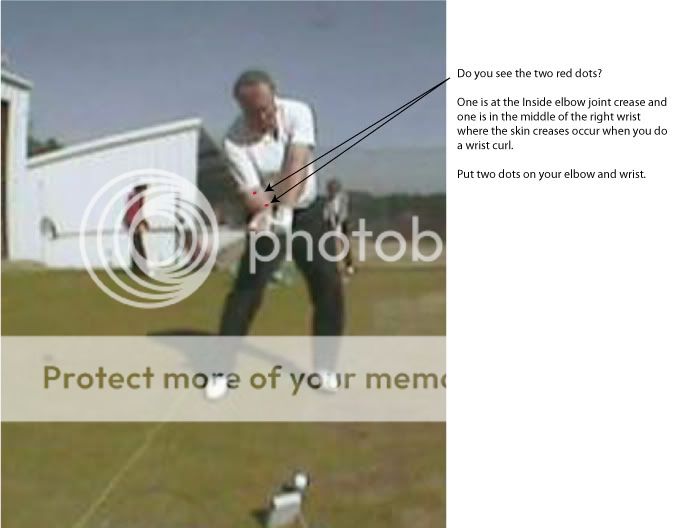
Get into his positions. The Clubshaft is close to parallel to the Plane Line. Are your Dots facing up toward the sky? They should.
Perform the Following with a Bent and Level Right Wrist.
Swivel
1. Stay in that position and take your Left hand off the Club.
2. Do some right arm dumbell curls. Up and down. repeat.
3. Notice that the Clubface Swivels to the Plane when you bend your elbow and swivels back to vertical when you unbend your right elbow.
Swiveling is almost completely automatic with full swings. Unbend your right elbow until your right arm is straight and you'll see a complete pre-impact swivel to vertical.
Next: Horizontal Hinge - Simple.
1. Assume the positions of the Golfer above.
2. Do you see where the clubface is pointing? Yes. It's facing away from you and across the target line.
3. Take your left hand off of the club. Keep your right elbow bent.
4. move your right arm wedge (as a single unit) to your Left until the Clubface is facing your target by rotating your right forearm. It's ok to pivot a little. Your right forearm is now on the angle of approach, but not actually because it's still bent.
5. Are the two dots facing up? They should. Did you notice how easily the clubface closed? Yes. Was that difficult to do? no.
6. Assume the positions of the Golfer above.
7. Do you see where the clubface is pointing? Yes. It's facing away from you and across the target line.
8. Take your left hand off of the club
9. Unbend your right elbow until your arm is almost straight.
10. The dots are still facing up
11. move your right arm wedge (as a single unit) to your Left until the Clubface is facing your target. It's ok to pivot a little.
12. Are the two dots facing up? They should. Did you notice how easily the clubface closed? Yes. Was that difficult to do? no. Now, your right forearm is on the angle of approach that HK talks about. This is just like your right forearm wedge at Impact Fix.
13. Assume the positions of the Golfer above.
14. Do you see where the clubface is pointing? Yes. It's facing away from you and across the target line.
15. leave your left hand on the club.
16. Unbend your right elbow until your arm is almost straight.
17. The dots are still facing up
18. move your right arm wedge (as a single unit) to your Left until the Clubface is facing your target. It's ok to pivot a little.
12. Are the two dots facing up? They should. Did you notice how easily the clubface closed? Yes. Was that difficult to do? no.
13. Do you notice how your left wrist rolled and the back of the left wrist is facing the target. Yes.
14. Did you twist your right wrist? no
15. are the dots still facing up? yes.
16. Here is what you did. You Uncocked, Swiveled and Rolled On-Plane.
Now, make those motions with your right elbow moving as it would while doing normal golf swings.
Go hit some pitch shots. No More Shanks. Are the Dots facing up at Impact? Yes.
(For Hitters, the Dots are Facing the Target). If a Swingers wrist dot is facing the target, then he's mixing hitting and swinging.
Thank you for your great contribution. It's something that I'm going to study til I get blue in the face.
When Lynn is demonstrating the finish swivel for the swinger, on the impact bag, he is using the left arm.
When that is done with both hands on the club, what is powering the action? Pivot? left arm? right arm? All the above?
Good question, Chipingguru. Thanks!
Centrifugal Force -- driven by the Body's Transfer of Momentum Throw-Out Action (2-K, 2-M-4, 6-M-1) -- powers the Swinger's Finish Swivel. But, Swinging or Hitting, the Swivel Action is always a Left Forearm function (Sketches 2-K #4 and #5).
Remember, any Swivel Action is a true rotation of the Left Forearm and Wrist (indeed, the entire Left Arm Flying Wedge / 6-B-3-0-1). This as opposed to Horizontal or Angled Hinge Action (2-G) wherein the Wrists appear to Roll -- from Impact to the end of the Follow-Through / Both Arms Straight position -- but in reality are merely staying Vertical to either the Horizontal or Inclined Planes (and thereby producing respectively Clubface 'Close Only' or 'Close with Layback' Motions).
For example, the Release Swivel rotates the Left Wrist from its Turned condition ('palm down' to Plane) to its Vertical condition (at Impact) for Hinging. The Finish Swivel rotates the Left Wrist from its Vertical condition (at the end of the Follow-Through) to its Snap-Rolled condition ('palm up' to Plane) in preparation for the Finish.
Percy Boomer writes about how to have conscious control by feel instead of thinking about our shots. and that it's essential to feel and control the swing as a whole and not concentrate upon any part of it.
I guess that's fine, but it has to be after the mechanics has been mastered?
I think this goes to the heart of what hands controlled pivot is about. No need to wait for the perfect stroke, IMO.
OTOH, I Jack Nicklaus has said on numerous occations that he was capable of using 5 (?) swing keys while competing. I'm not sure of the exact number here, but it's a big one. But he didn't recommend more than one or two for the recreational golfer.
It's all about finding the right balance I guess. Been trusting and maintaining. And it's certainly easier to take on the right attitude in the short game than in the long game. I guess most people can learn a thing or two about hands controlled pivot from their short game.
Percy Boomer writes about how to have conscious control by feel instead of thinking about our shots. and that it's essential to feel and control the swing as a whole and not concentrate upon any part of it.
I guess that's fine, but it has to be after the mechanics has been mastered?
The example I use all the time is that of tying your shoelaces. In the beginning, it is a learned, laborious, fumbling, frustrating set of consciously controlled mechanics (make the 'bunny ear', etc.). In the end, it is one cohesive feel, executed totally subconsciously, with barely even a conscious thought triggering the act. And so it is with the Golf Stroke.
The example I use all the time is that of tying your shoelaces. In the beginning, it is a learned, laborious, fumbling, frustrating set of consciously controlled mechanics (make the 'bunny ear', etc.). In the end, it is one cohesive feel, executed totally subconsciously, with barely even a conscious thought trigger. And so it is with the Golf Stroke.
I guess you are talking about golfers with control of the game (via control of the ball with the club face via control of the flat left wrist)? It's easier to trust your swing when everything is working just fine and the feedback is positiv. But not everybody enjoys this type of game control. I guess this confident, automatic, subconscious motion (that makes the shots) belongs to better players and not so much to high hcp players? But everybody is hoping to get better and it's a good goal to aim at + a lot of hard work I would think...
I think this goes to the heart of what hands controlled pivot is about. No need to wait for the perfect stroke, IMO.
OTOH, I Jack Nicklaus has said on numerous occations that he was capable of using 5 (?) swing keys while competing. I'm not sure of the exact number here, but it's a big one. But he didn't recommend more than one or two for the recreational golfer.
It's all about finding the right balance I guess. Been trusting and maintaining. And it's certainly easier to take on the right attitude in the short game than in the long game. I guess most people can learn a thing or two about hands controlled pivot from their short game.
Why is it easier to take on the right attitude in the short game? Some of the most difficult shots belong to the short game and then there is this darn problem of the keeping the head down and not peeking up to see the result of a difficult shot.
I'm not sure how this fits in with TGM teaching, but I found it interesting to see the 3 different ways to get the club in the slot - especially the third one - the sledge hammer variant. It looks like OTT, but isn't. Tempting...




 Linear Mode


