If you feel for it - you can send me a private message and I can post it here, if you want.
..............
Hinge Action is the Left Wrist remaining Vertical to one of the Three Basic Planes. Swivel Action (or Wrist Action) is Turning or Rolling away from that Vertical condition.
With Horizontal and Angled Hinge Action, the Vertical Left Wrist appears to Roll through Impact. However, as long as the Wrist remains Vertical, there has been no independent rotation of the Hand (and hence no Swivel).
__________________
Yoda
- See more at: http://www.lynnblakegolf.com/forum/s... RQZ89bp0.dpuf
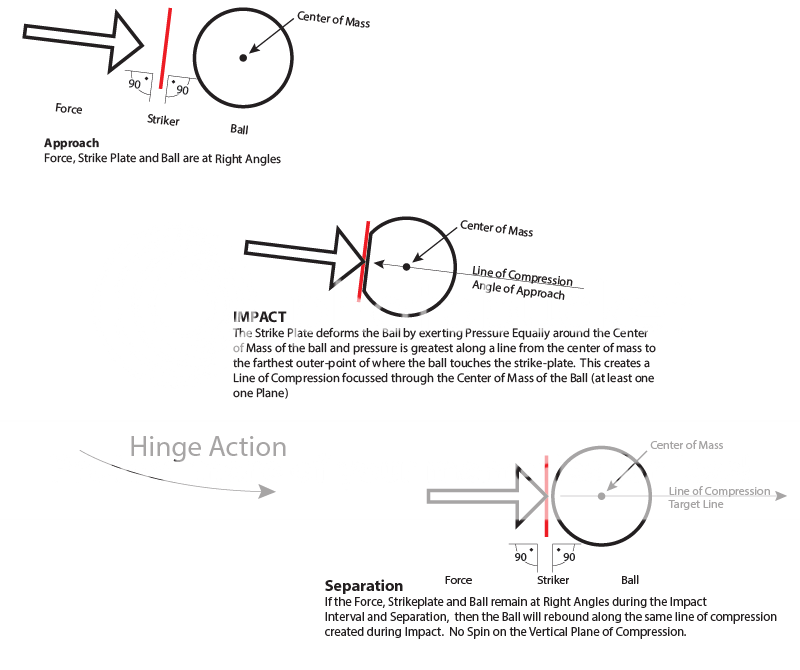
We strike the ball with the force and Strike-Plate square to the Angle of Approach. Then, we use a Hinge Action to:
not disturb the Right Angle relationship of Force, Strike-Plate and Ball
Rotate the Line of Compression to align with the Target at Ball Separation
Another way to understand the Concept of Line of Compression.
If we drop a Ball, then a Force (Gravity) will pull the ball into the Strike-Plate (Sidewalk). If the Strike-plate is square to the force (if the sidewalk is level), during Impact, pressure against the ball will be equally applied around the center of Mass of the ball.
When the Pressure against the ball is greater than the force that deformed the ball, then the Ball will rebound away from the Strike-Plate. If the Strike-Plate, Ball and Force remained at right Angles, then the Ball will rebound along the same line of compression created from Impact.
If you Swivel the Right Wrist Through Impact, then a Straight Line of Compression cannot be created, maintained or manipulated to Align to the Target.
More knowledge:
The Ball is stationary. The Clubface moves into the ball. The Ball will move as soon as it offers greater resistance than the pressure it receives from the clubface force. By the time the ball has moved 1/1000 of an inch, it is moving at the same speed as the Clubface. From the balls point of view, at this point, the Clubface is a stationary object. The Ball puts pressure on the Clubface during rebound. If the shaft isn't pre-stressed or stiff enough for the swing speed, some of the balls compression will wasted in pushing back the clubface during its rebound escape.
A #2 Pressure Point Swinger focuses on Approach Speed while the #3 Pressure Point Swinger has his attention on Separation Speed and uses the #3 Pressure Point to pre-stress the clubshaft to reduce rebound compression loss.
Another guy with the wrong approach. Adam thinks he's moving the bottom of the clubhead arc around and compensating for changes. To him, the "bottom of clubhead Arc" = Low Point. What he says is irrelevant to me because it bears no resemblance to Low Point according to Homer Kelley.
Low Point is the Heart of the Machine. It is the Basis for all of the Geometry of the Golf Swing. Go ahead and move the ball wherever you like, but don't mess with the one thing that the entire system is based upon.
Low Point is an Alignment. It occurs when the Clubshaft is perpendicular to the Plane Line, the Clubface is Square to the Plane Line and this combined alignment is Aligned to the Bottom of the Arc and the Arc is Aligned to the Center of the Radius of the Primary Lever. The Alignment is inherently designed and built into every club.
All that Adam is actually telling you to do, is hit the Ball before you hit the ground.
Hopefully something educational comes out of this ... this is his answer: "not sure I understand. What does he think I got wrong specifically?
and yes, I am saying hit the ball before the ground. And that, all things being equal, a low point which is lower will enter the turf earlier."
I don't mean to offend him. I'm just saying that his article is not about Low Point. His "Ball Flight Laws" section is also misinformed. He is repeating Jorgenson, Trackman and some old Golf Books. Path is a misinformed concept. Get up to date. All of his is related (Geometry of the Circle, Right Forearm Tracing, Right Forearm Angle of Approach, Low Point). Learn how the direction of Force produced by the Clubshaft can be changed. Homer Kelley spent much of the Geometry of the Circle outlining the concept.
When Homer Kelley coined the term "Low Point", it had nothing to do with how high or low the Clubhead is above or below ground. Low Point is an Alignment. Clubshaft, Clubhead, Clubface, and the Center of Radius for the Primary Lever. This confluence of Alignments can only occur at one single point on the Clubhead Arc (and it is at the bottom of the arc because it's opposite the Radius of the Swing).
When your Clubshaft is perpendicular to the Plane Line and on the correct Lie Angle Plane (for that club), and the Clubface is square to the target and the COG of the Clubhead is exactly opposite your left shoulder. You are aligned to Low Point.
Here is $1,000,000.00 worth of Knowledge-Education
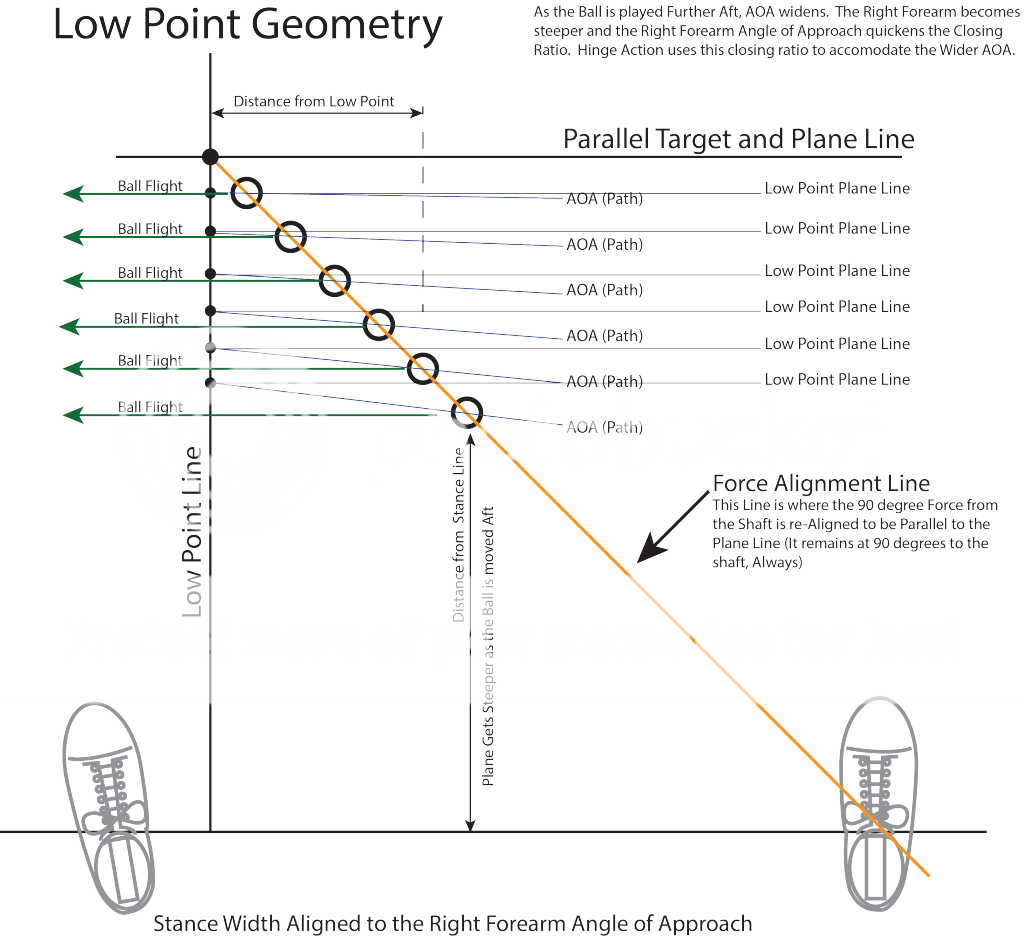
The Force in a Golf Swing is at 90 degrees to the Shaft. Low Point, is where this 90 degree force also becomes "Parallel" to the Plane Line (Target Line). Normally, if you played the Ball straight back from Low Point, the 90 degree force from the shaft is aligned to the right [Angular Force, most everyone calls this "Path" (mistaken term)], and if you square the clubface, you will produce a "Hook".
Question: Per Homer Kelley, In order to hit a straight shot, when the Ball is played 3" aft in your stance, How do you re-align the 90 degree force coming from the shaft so that it is parallel to the plane line?
Answer: Per Homer Kelley, Stand 3" closer to the Ball and align the Clubface square to the base line of the inclined Plane.
This is Low Point Geometry. Homer Kelley was first to discover, understand, and fully conceptualize this Geometry.
To Help you further:
Ball played to the Right of the Orange Line with a square clubface will Hook.
Ball played to the Left of the Orange Line with a square clubface will Slice.
Ball played on the Orange line with an open Clubface will Fade.
Ball Played on the Orange line with a closed Clubface will Draw.
Everyone thinks that ball laws are about Path and Clubface. More precise, they're about Force and Alignment. The Path is always on-plane. Angle of Approach helps you understand that the Force is Angular.





 Linear Mode


